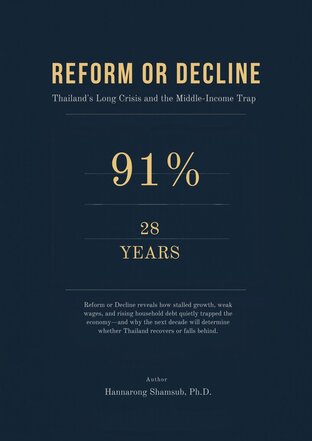
This book rgues th t Th il nd’s current
household debt crisis is the final stage of a
longer structural crisis that began with the
1997 Tom Yum Kung crisis. Although
Thailand stabilized its financial system after
1997, it failed to rebuild a dynamic growth
engine capable of sustaining productivity,
wages, and broad-based upward mobility.
Over time, unresolved weaknesses migrated
from banks to firms and finally to
households.
The central claim is that Thailand is trapped
between macroeconomic stability and
developmental stagnation. Financial
conservatism, weak competition,
underinvestment, inadequate human-capital
upgrading, and consumer-credit expansion
have combined to produce a household
debt trap. The book concludes that
Th il nd’s recovery requires simult neous
reform: coordinated household debt
restructuring, productivity revival, developmental finance, education reform,
stronger competition, and a renewed
commitment to structural transformation


 Facebook
 X


 LINE


