When AI Enters the Frontline, Who Makes the Final Decision?
In the past, when people talked about AI, many probably thought of data scientists or sophisticated technology systems far removed from frontline operations. Today, however, AI is moving closer to frontline work than ever before.
Cameras help detect whether personal protective equipment (PPE) is being used correctly. Sensors monitor workplace and environmental conditions. Alert systems identify abnormal equipment conditions. Computer vision helps screen for defective products. Predictive models indicate which assets should be inspected first.
As AI becomes embedded in these processes, it is no longer the responsibility of IT alone. It involves engineers, operators, supervisors, HSEQ professionals, maintenance teams, quality teams, and everyone who uses AI-generated information to support decisions.
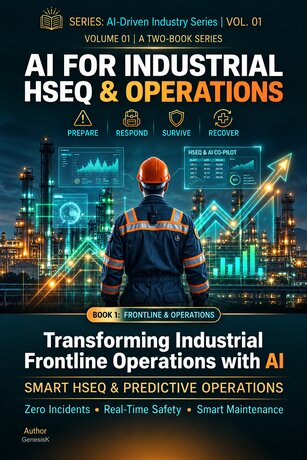
That is why I wrote this book.
The purpose is not to turn readers into experts in machine learning or algorithms. Rather, it is to help people in real working environments understand AI, use it appropriately, and ask the right questions about it.
Where does the data come from?
Is the sensor actually measuring what we think it is measuring?
If the dashboard says everything is normal but actual conditions in the field suggest otherwise, which should we trust?
Who has the authority to override the system?
And perhaps the most important question..
If AI provides incorrect information, who remains accountable for the decision?
This book therefore follows a practical pathway…
Identify → Assess → Pilot → Verify → Govern
This pathway guides the use of AI from identifying the real problem and assessing readiness, through piloting within a controlled scope, verifying results against actual conditions, and finally establishing clear roles, responsibilities, and governance.
At the heart of this approach is Human-in-the-Loop.
Human-in-the-Loop does not simply mean having someone watch AI outputs, listen to AI-generated summaries, or view a polished automatically generated dashboard.
It means ensuring that people retain sufficient knowledge, information, authority, and accountability to verify AI outputs, question them, and stop or override the system when necessary. In an industrial environment, an AI error is not simply a "wrong answer."
It could mean a defect reaching the customer, an unnecessary equipment shutdown, or increased risk to people, processes, and operations.
For this reason, this book does not treat AI merely as technology. It treats AI as part of a broader system in which people, data, sensors, processes, and technology must work together.
The goal is therefore not…
"How do we make people trust AI?"
but rather…
"How do we enable people and AI to work together critically, safely, and responsibly?"
Once AI begins delivering results at the operational level, the questions will also change.
Instead of simply asking….Does the AI work?
Organizations will begin asking….
Does AI create real business value?
Should we continue investing, or should we stop?
When should a PoC be scaled to the organizational level?
Who should own AI risk?
How should executives govern AI?
These questions connect frontline AI with AI at the enterprise decision-making level.
They also provide the starting point for the second book in this series…
AI for Executive.. Operations & Risk Management
วันที่วางขาย
25 พฤศจิกายน 2569
ราคาปก
350 บาท (ประหยัด 2%)


 Facebook
 X


 LINE


